

Smart Compliance Through Outreach with Rentalscape
How the City of Norman Achieved 84% STR Compliance through Outreach with Rentalscape
At a Glance
Jurisdiction
City of Norman, Oklahoma
Program Lead
Jeanne Snider, Assistant City Attorney
Context
Third-largest city in Oklahoma (~130,000 residents), home to the University of Oklahoma; STR (Short-Term Rental) demand peaks around ~8 home football Saturdays a year, plus a longer, lower-intensity bump during Oklahoma University's baseball season (Feb–June, home games at L. Dale Mitchell Park — reigning 2026 national champions)
Products
Rentalscape, Outreach
Key Outcomes
235
compliance letters sent
84.3%
positive resolution
$542,348
in verified direct revenue
01 - The Challenge
Why Norman Struggled to Track Its Short-Term Rental Market
Monitoring STRs was a complex task. Before 2024, Assistant City Attorney Ms. Jeanne Snider fielded neighbor complaints and researched the issue manually.
Downtown Norman, known as the "City of Festivals," is home to more than 40 local bars and restaurants, boutiques, and green spaces, and hosts more than 25 festivals a year, including the Norman Music Festival, which draws over 70,000 people in a single weekend, alongside the Fred Jones Jr. Museum of Art, the Sam Noble Oklahoma Museum of Natural History, and Lake Thunderbird State Park. But Norman's energy is, above all, collegiate: the University of Oklahoma dominates the landscape, and its football Saturdays and February-to-June baseball season, with the team as the 2026 national champions, set the rhythm of the city's short-term rental market, concentrating the biggest wave of visitors into a handful of weekends.
In 2018, the Norman Transcript reported the case of a neighbor who flagged an "illegal hotel" that had been operating for months in his residential neighborhood. By then, the monitoring service the city relied on was already tracking more than 150 active STR listings, and the City Council Oversight Committee was fielding complaints about noise and a lack of parking space, on top of a structural issue: Airbnb remitted a single aggregate monthly payment to the city, with no property-level breakdown, making it impossible to tell who was paying the occupancy tax and who wasn't.
At its core, the debate was also one of classification, whether an STR should count as a transient residential use distinct from long-term rental, and whether it required case-by-case approval or should be a permitted use by default.
As a result, the city moved to regulate the STR market, and Norman's short-term rental ordinance took effect on August 27, 2020. The ordinance requires an annual license for every STR and permits them in nearly all zoning districts, with the exception of industrial and rural commercial zones. Additionally, to license and renew, STRs must stay current on the occupancy tax, a rate that has climbed from 8% to 10% as of July 2026. The city has built its compliance program almost from scratch.
02 - The Solution
How Norman Automated Rental Monitoring Through Structured Outreach
Norman partnered with Deckard Technologies in 2024, adopting the Rentalscape platform and its structured letter Outreach campaign. The program handles mailing list development, and the generation, printing, and mailing of letters to identified STR hosts, using verified property and owner data within Rentalscape.
The campaign consists of three sequential letters, escalating in tone with each mailing to reinforce the seriousness of continued non-compliance. Each letter includes screenshots of the detected listing, so the recipient can clearly see the basis for the contact and the rental activity observed. Rentalscape tracks how many letters each property has received, giving the city visibility into which operators have already received repeated notices and still haven't complied, key information for prioritizing enforcement. All letter templates are reviewed and approved by the Norman team before being sent, and mailings are synced with calendar and active-listing data, reaching operators right when their ad is live online.
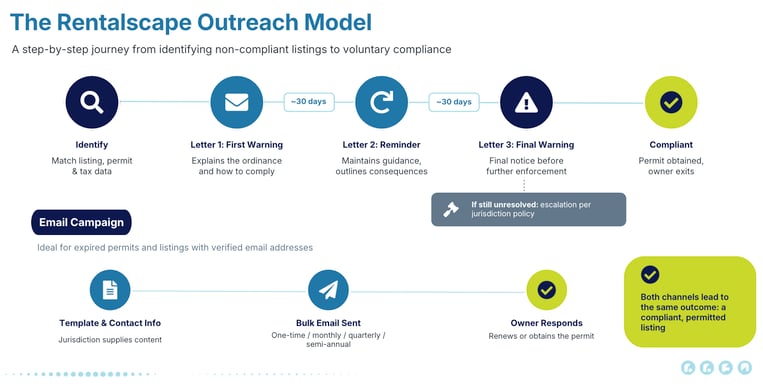
Figure 1: The Rentalscape Outreach Model — a step-by-step journey from identifying non-compliant listings to voluntary compliance, combining a three-letter mail campaign with an email Outreach channel. Source: Deckard Technologies, Internal Documentation.
On the city's side, the program is run by a three-person team, each with more than 25 years with the city: Ms. Jeanne Snider (legal, first point of contact), Ms. Mindy Aynes (finance and occupancy tax), and Ms. Janita Hatley (code enforcement). Deckard identifies suspected unlicensed properties and sends the letters, while the city's role centers on personalized follow-up for each case, handling calls one by one and responding to emails from recipients with questions about their notices.

I have a lot of other responsibilities, but we kind of have a team... All emails come to me or first-time phone calls come to me, and then I talk to Janita and Mindy, and we figure out how to basically track these people down."
The Norman team’s personalized work is backed by technology: Rentalscape makes identification and mailing visible and scalable, while the team's judgment and human contact are what ultimately close each case.
03 - Results
What a Mid-Sized City Can Expect from Structured Outreach
Over a 24-month period, Norman issued 235 compliance letters. As of the report's cutoff date (May 2026), 84.3% of recipients reached a positive resolution, either by obtaining a license or removing their listing. The following are the most tangible results:
|
1
|
Compliance happens fast |
Mostly without escalation. 60.9% of recipients resolved the matter with a single letter, and only one property in two years required a Final Warning. Median time from letter to permit was 67 days.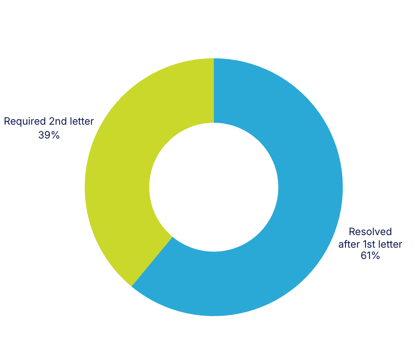
Figure 2: STR operators who reached compliance after the first letter (61%) versus those who required a second letter (39%). Source: Deckard Technologies, Internal Documentation.
|
2
|
Properties attributable to the campaign |
It generated $542,348 in verified direct revenue for the city, since the program began. The figure below summarizes the key results.
235
Compliance letters sent over 24 months
84.3%
Positive resolution rate, roughly double the 35-40% typical in comparable jurisdictions
$542,348
in verified revenue attributed to the campaign
67 days
Median time from letter to permit
Figure 3: Summary of key program results. Source: Deckard Technologies, Internal Documentation.
|
3
|
The philosophy behind these results |
Ms. Snider sums up the philosophy behind these results as personal contact: "...it's the personal contact that we just do in the city of Norman. Customer service is what's got our compliance so high." And that same personal contact is backed by Deckard handling the operational side:
"I don't even worry about all that. Deckard takes care of all that. They send out the letters. We start getting better compliance." — Jeanne Snider, Assistant City Attorney, City of Norman.
That combination of automation and hands-on follow-up is what has kept compliance climbing.
04 - What's Next
Staying Ahead of a Bigger Season
With greater visibility into its STR market, Norman now runs a sustained, data-informed approach. Norman's initial enforcement sweep has settled into a steady, ongoing cadence, arriving just in time for football season now that Norman is home to a team in the SEC (Southeastern Conference).
Discover how municipalities are using Rentalscape to gain visibility into STR activity and support long-term compliance efforts.
Book a Demo