


.png)
GovTech · STR Compliance · Buyer's Guide
How to Evaluate an STR Compliance Platform:
A Buyer's Checklist for Local Governments
By Erika Meneses Oct 13, 2026 12 min read
Cities and counties regulate short-term rentals (STRs) to protect housing, limit noise, parking, and trash problems, keep guests safe, and collect lodging tax (Gandhi et al., 2019; Shen et al., 2025). Strict limits, however, can cost tourism income (Shen et al., 2025), so for tourism communities the goal is to keep the visitors and make sure every operator registers and pays. That is harder than it sounds: in Boston, only 41% of listings showed a valid license (Gyódi et al., 2025). Closing that gap is what an STR compliance platform is for, and choosing one comes down to six questions: how many listing sources it monitors beyond the largest platforms, whether it was built for public-sector work, what results the vendor can document and who verified them, how listings get matched to parcels, whether it supports the whole short-term rental lifecycle, from a neighbor's complaint to a permit renewal, and how clear pricing and implementation are.
These questions come from the conversations we have with cities and counties every week. Deckard Technologies was founded in San Diego in 2018 to support public-sector compliance in the U.S. real estate market. It is still privately held and has never been acquired by or merged with another GovTech vendor, so the team that built Rentalscape is the team that supports it. More than 500 jurisdictions use it today, and many had already tried an STR tool that did not work out. Having bought once, they ask sharper questions the second time, and this checklist is built from them.
Underneath most of those questions sit two concerns: revenue and staff time. Every rental a platform finds and registers is short-term rental tax (transient occupancy tax, tourist development tax, or a local equivalent) that was going uncollected, and jurisdictions running Rentalscape see tax collection rise 40% on average. “We went up over 500 properties with Deckard. We would have never found even probably a fifth of them, and that is without exaggeration,” said Kathleen Lara, County Treasurer, Sullivan County, NY, a 900+ STR market. The same platform takes work off a small team: automated outreach, registration, and renewals replace manual searches and spreadsheets, and Deckard reports that work that once took 80 hours over two weeks now takes minutes. Ask every vendor to show how their platform delivers on both.
What a strong answer sounds like, at a glance
1. How many listing sources does the platform actually monitor?
Start here, since a platform can only register the rentals it finds. Ask for a number, and ask what sits beyond the largest two or three platforms. Direct-booking sites, regional marketplaces, and small platforms are where unregistered operators tend to list, and where the uncollected tax sits.
Deckard's Forensic AI engine monitors more than 15 million listings across 10,000+ rental websites in real time, which is how Rentalscape detects unlisted or disguised rentals with 35% more accuracy than competitors. Ask any vendor for its own number, in writing.
2. Was it built for government compliance work, or adapted from something else?
Your team works with ordinances, notices, and hearings every day, so the software should too. Look for a platform where permits, notices, hearings, and records requests are built-in features, not exports added to an investor or property-management tool.
|
||||
|
||||
|
3. What results can the vendor document, and who verified them?
Ask every vendor, including us, for a compliance rate, a revenue change, and a jurisdiction that will confirm both. Ours: jurisdictions using Rentalscape reach compliance rates of up to 95%, and tax collection rises 40% on average. We will put you on the phone with the jurisdictions behind both. Published case studies: 95% compliance in the Town of Mount Pleasant, SC, 100% in the City of Deadwood, SD, and 84% in the City of Norman, OK.
Ask where the money actually comes from
Ask each vendor to walk you from "property found" to "money in the general fund," and note which steps the software handles and which land on your staff:
- Tax from newly identified rentals: properties that were operating and not paying, usually the largest line in year one.
- Registration and permit fees: automated outreach drives registrations, and each one is fee revenue, without adding headcount.
- Remittance from registered operators: registered is not the same as paying. Ask whether operators can file and pay through the platform, and whether it checks what they report against listing activity. Rentalscape includes STR tax filing and payment tools.
- Back assessments and penalties, where your ordinance allows them: ask whether the evidence report is built to support an assessment, not just a courtesy notice.
A platform worth buying returns more to the general fund than it costs. Any vendor you shortlist should be able to show this path with its own numbers.
Read every compliance rate by its denominator
A compliance rate without a denominator is a marketing number. Ask: compliant out of how many identified, and who did the identifying?
Ilustrative example: a jurisdiction that knows about 200 rentals with 180 registered can report 90% compliance. If a better discovery engine finds 600, the real rate was 30%, and the 400 nobody knew about were 400 properties paying no tax.
4. How does the platform find, match, and flag a property?
Your staff will work with this part of the platform most. For reference, Rentalscape scans daily and ties each listing to a parcel number, with analyst review before anything reaches your team.
Deckard's Forensic AI engine monitors more than 15 million listings across 10,000+ rental websites in real time, which is how Rentalscape detects unlisted or disguised rentals with 35% more accuracy than competitors. Ask any vendor for its own number, in writing.
|
||
|
||
|
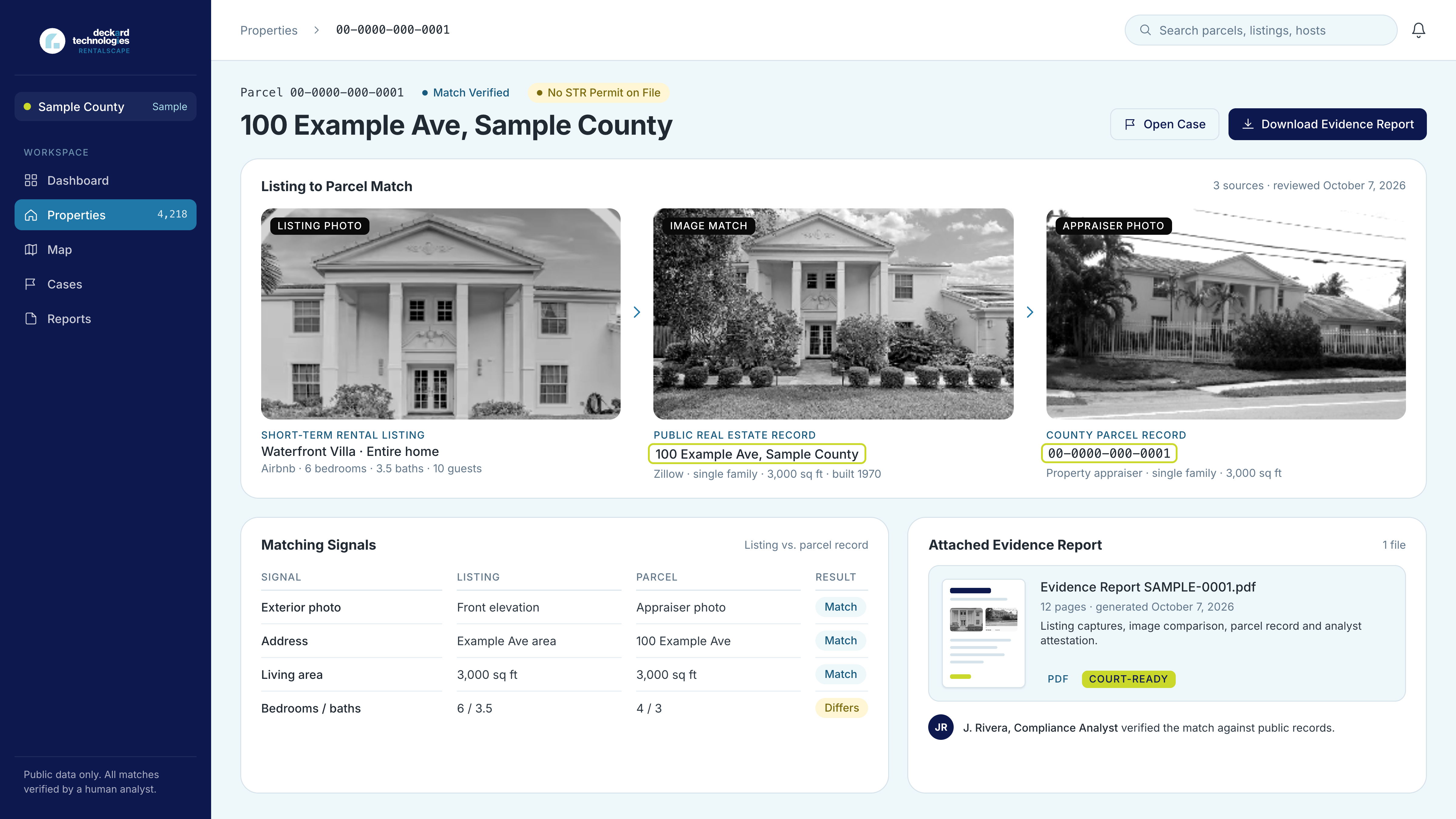
Figure 1: Rentalscape property record. A short-term rental listing is matched to its parcel number by comparing photos, address, and property attributes from public sources. The evidence report is attached to the record. Illustrative image with anonymized data from a sample jurisdiction; the actual Rentalscape interface may differ.
5. Does it cover the whole short-term rental lifecycle?
Finding a rental is only the start. That same property will need a permit, tax filings, maybe a complaint and an inspection, and a renewal next year. If each step runs on a different tool or inbox, your staff has to connect them by hand, and that is where properties slip through.
In a demo, follow one property through a full year:
|
||||||
|
||||||
|
Rentalscape covers each step: listing identification across 10,000+ rental websites, a Registration & Renewal Portal, a Tax Payment Portal, a 24/7 Complaint Line and online form, and an Inspection Portal. In San Bernardino County, CA, the complaint line processed nearly 1,900 complaints in a year. Whichever vendor you choose, ask whether these pieces share one record and one login.
6. How clear are the pricing, contract terms, and implementation timeline?
If a vendor cannot explain the price in one sentence, you cannot budget for it.
|
||
|
||
|
How should you run the evaluation itself?
Here is how to put the six questions to work, whether you are running a formal RFP or three demos in a week:
-
Put identical questions to every vendor, in writing. Use the six above, and ask for numbers where they apply.
-
Ask each vendor for a sample discovery on your jurisdiction. Compare how many properties each one finds, how many are new to you, and what tax those new properties represent. Set that next to the annual fee, and you have your business case.
-
Bring the people who will use it. Have a code officer or tax clerk ask to see an evidence report and a notice workflow, not just the dashboard.
-
Call the references and ask the denominator question. Compliant out of how many identified, before and after? Ask what tax receipts did in year one and what implementation really took.
-
Score each criterion 0 to 2, weighting coverage and methodology highest. Then put the winner's written answers on pricing, term, data ownership, and go-live into the contract.
What is an STR compliance platform?
An STR compliance platform is software a local government uses to identify short-term rental properties operating in its jurisdiction, match them to parcels and owners, reconcile them against permit and tax records, and manage registration, tax collection, outreach, complaints, and enforcement from one system. Deckard Technologies' Rentalscape is one example, built for public agencies.
Where to start
When a jurisdiction puts these six questions to us, it gets written answers and references. Ask the same of every vendor. To see how Rentalscape answers all six, or to run a sample discovery and see what uncollected revenue it turns up in your jurisdiction, get in touch. We have been hearing these questions since 2018, and the same team will be here to answer them in year three.
 LinkedIn
 Facebook
 X
X