

GovTech · Registration · Rentalscape
Marion County, Florida
A Program With Different Beginnings, and a Registry That Kept Growing
By Stacey Kurtz August 19, 2026 5:40 min read
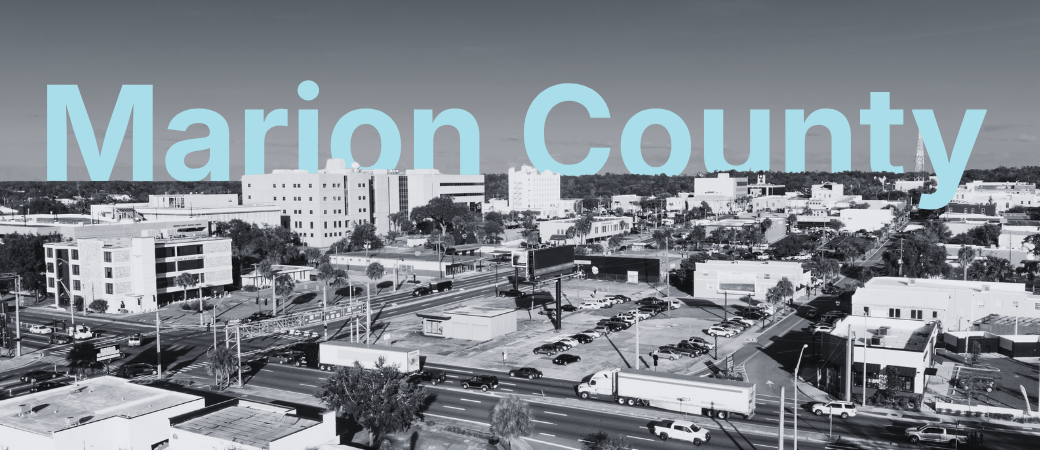
Marion County is the "Horse Capital of the World," home to the largest equestrian complex in the United States, and hosts two or three major horse events each year. The county is also home to the Ocala National Forest, dozens of natural springs, and Silver Springs, drawing visitors year-round. With a population that now tops 430,000, the result is steady tourism, and a lot of it shows up as short-term rentals: farm properties, guest houses, cottages near the forest or within driving distance of the arena. For the Tax Collector's Office, that made short-term rental activity scattered across the county and hard to pin down without the predictable high season of a coastal town.
A Program That Needed a Fresh Start
Marion County had tried managing short-term rentals before, more than once, between 2019 and 2020. Those attempts hadn't gotten them where they needed to be. By the time Deckard came along, the Tax Collector's Office already knew exactly what questions to ask and what results they needed to see.
In 2024, the county started working with Deckard's Rentalscape platform. At that point, the county had just over 100 registered short-term rental properties. Given Marion County's size and tourism profile, that left a huge share of the real market off the radar.
Today, that figure is almost 1,400 registrations.
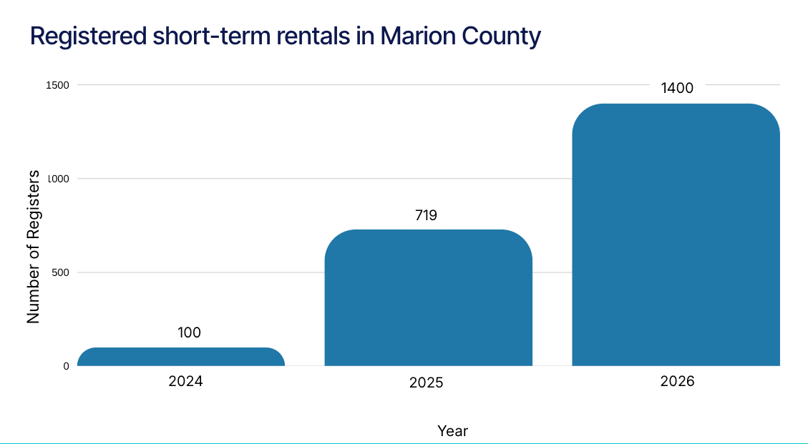
Figure 1: Registered short-term rental properties in Marion County, August 2024–2026. Source: Marion County Tax Collector's Office (2024); Rentalscape internal data (2024–2026).
That growth is mostly about detection. The team stopped relying on manual searches and let the platform handle identification continuously instead.
What the Team Sees Every Day
Before Rentalscape, finding an unregistered property meant manual searches, listing by listing, platform by platform, with no way to be sure every existing one had been checked. A slow process that could never keep pace with how fast the vacation rental market grows.
Rentalscape monitors short-term rental listings across Airbnb, Vrbo, Booking.com, and other sites continuously, and cross-references what it finds against Marion County's own property records. When a listing appears that doesn't match a registered account, the team can follow up directly, instead of spending hours searching for it by hand. For years, that search fell entirely on Tammy McCann, Deputy Tax Collector for Marion County. She described what changed:
"Before working with Deckard Technologies, I was finding short-term rentals on my own, and it took hours upon hours just to identify a handful of accounts. [...] Their technology completely streamlined that process and helped us more than double the number of registered rentals in Marion County." — Tammy McCann, Deputy Tax Collector, Marion County,PR Newswire, December 2025
What Registrations Actually Mean
Marion County collects close to $7 million a year in TDT revenue, reported through the Tourist Development Council to the Board of County Commissioners. In the past, that local control has funded things like highway signage along I-75 and tourism promotional videos, according to county officials.
Every short-term rental that operates unregistered is a property that isn't paying TDT. That's a direct revenue loss, and it's also a fairness question: a hotel or motel in Ocala pays TDT on every night it rents a room. An unregistered short-term rental doesn't.
Conversations about how much flexibility counties should have over TDT revenue keep coming up in Tallahassee. Several bills touched on that question this session alone, from adjusting how much TDT money must go toward tourism advertising to opening it up for other local priorities. The topic keeps resurfacing, session after session. A more complete, accurate registration base doesn't settle that debate, but it does mean the county has better information going into it whenever it comes back around.
The TDT isn't the only active tax conversation in Marion County this year. As mentioned in the first post of this series, this November Florida votes on Amendment 3, the constitutional amendment that would raise the Homestead Exemption and lower the assessment growth cap on non-Homestead properties, a category that includes many STRs. Just this week, a judge ordered the ballot language rewritten for being biased, and Florida's attorney general released the new version on August 13. Whatever the outcome in November, having clarity on which properties operate as STRs in Marion County makes it easier for any future adjustment to the property tax to be applied precisely.
This Is the First of Seven
Marion County is the first jurisdiction we're featuring in this series, which covers seven Florida counties and cities where Rentalscape is active. Each one started from a different place and faced its own version of the same challenge. We'll be publishing the rest over the coming weeks.
|
If you're a Florida Tax Collector, compliance officer, or TDT administrator thinking about where your own program stands. We're happy to walk through what Rentalscape does in practice. Book a Demo |
 LinkedIn
 Facebook
 X
X