


Rentalscape · Short-Term Rentals · Code Enforcement
St. Johns County, Florida
How St. Johns County, Florida Is Rebuilding Its Short-Term Rental Registry Around Code Enforcement
By Kandi Marler, Head of Client Success Nov 13, 2026 5 min read · 8 min listen
This is the fourth story in our Florida Customer Spotlight series. St. Johns County is at the earliest stage of the group, with the public launch of its new system still ahead.
St. Johns County began regulating short-term vacation rentals in 2021. The rules took effect that May as an amendment to the Land Development Code, and since November 2021 owners in unincorporated areas have had to register each rental unit and renew every year (News4JAX, 2021; St. Johns County).
Five years later, the rules are largely in place, but the system behind them is changing. This year, after a competitive selection process, the County's Code Enforcement team chose Deckard to replace its previous registry provider, covering short-term rental registration, complaint intake and monitoring of online rental listings. In St. Johns, the registry belongs to Code Enforcement. For an enforcement team, a registry is useful only if letters reach the right owners, complaints can be acted on legally, and operators have a simple way to comply. This is a look at how the County set up each of those pieces.
What the ordinance asks for
Like every Florida jurisdiction that adopted its rules after June 1, 2011, St. Johns works within limits set by the state. A local ordinance may not prohibit vacation rentals or regulate how long or how often they are rented (Fla. Stat. § 509.032(7)(b)). What a county can regulate is how a rental operates, and that is where the St. Johns rules focus: the number of occupants per room, available parking, a responsible contact reachable 24 hours a day, and a page of information posted at the main entrance.
Registration is also where the records of several agencies meet. Along with the application and fee, an owner submits a local business tax receipt, a license from the Florida Department of Business and Professional Regulation as a transient public lodging establishment, and a copy of the Florida Department of Revenue Certificate of Sales and Use Tax. Owners who rent through platforms such as Airbnb or VRBO also submit a statement that the platform collects and remits the tax for them (St. Johns County).
The rules do not apply everywhere in the unincorporated county. Rentals west of the Intracoastal Waterway are exempt. So are homes the owner lives in full time and has declared as homestead, including a two-family property where the owner holds both units and lives in one, and multi-family dwellings governed by a property owners, condominium or homeowners association, or with on-site property management (St. Johns County). The ordinance also allows the County to contract with an outside entity to develop, operate and maintain the registry and collect its fees (Land Development Code Sec. 2.02.04.B.19).
St. Johns County's short-term rental market
St. Johns has a large and steady rental market. Over the past two years, roughly 6,150 to 6,700 listings were live online in a typical month. A listing is not the same as a property, since one house can be advertised on several platforms. Since mapping began, Rentalscape, Deckard's short-term rental compliance platform, has matched 9,875 listings in the County to 3,059 properties, 2,907 of them short-term rentals (Figure 1). Those addresses are the starting point for registration and outreach.
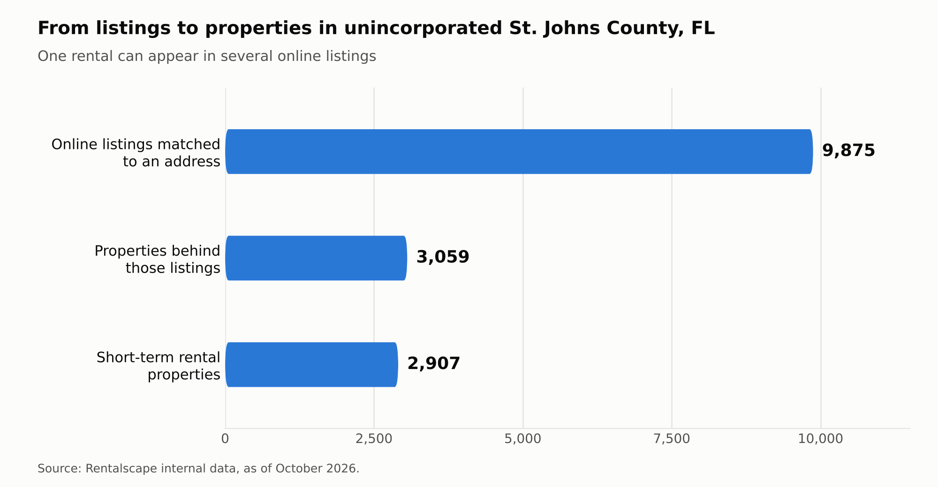
Figure 1. From listings to properties in unincorporated St. Johns County. Source: Rentalscape internal data, as of October 2026.
Before implementation, the County asked Deckard to map listings to addresses. That task was finished before the on-site kickoff, so Code Enforcement could see its own market in the platform on the first day.
What Code Enforcement needed
Before the first letter goes out, the new system had to get three things right.
Exemptions handled before outreach
Enforcement starts with knowing who the rules apply to. A letter sent to an owner the ordinance does not cover creates work for staff and confusion for the resident. One of the first questions during setup was which properties should not hear from the County at all. In St. Johns, the exemption filter was built from property use codes rather than a list of addresses, and Deckard and the County confirmed the list of exempt properties before outreach begins.

Complaints that meet state law
Complaints are the other way a case begins, and in Florida, how a complaint arrives determines whether Code Enforcement can act on it. Since July 1, 2021, Florida law has not allowed a code inspector to open an enforcement proceeding from an anonymous complaint. A person reporting a potential violation must give their name and address first, unless the violation poses an imminent threat to public health, safety or welfare (Fla. Stat. § 162.06(1)(b)).
The County's new complaint form requires the complainant's name and mailing address, and asks for a phone number so staff can follow up. Those fields are recorded with each complaint. A 24/7 complaint hotline is also part of the new system.
Continuity for registered operators
The other half is making compliance easy for operators already following the rules. Operators who were already registered do not start over: when they sign in to the new portal with the email they used before, their existing records are linked to their account.
How short-term rental registration works in St. Johns County
For new applicants, the portal collects what Code Enforcement needs to approve a registration in one pass:
|
||||
|
||||
|
A phased launch for the new registry
The County chose to roll out in stages. A soft launch opens registration first to operators who were already waiting to register or renew, which tests the system with real applications before the public launch. The second stage sends outreach letters to every non-exempt property identified in Rentalscape.
More stories from Florida
Earlier in this series, we looked at Marion County, where the Tax Collector's office more than doubled its registered rentals; Nassau County, which went from an unknown baseline to 81% compliance in its first year; and Melbourne Beach, a small town that built its first working list of short-term rentals. St. Johns is the first in the series still at the start of its rollout. We will come back to it once outreach letters are out and registrations start coming in.
|
Working on short-term rentals in your Florida county? Our team works with counties and cities across the state on registration and code enforcement. Book a Demo |
 LinkedIn
 Facebook
 X