


GovTech · STR Compliance · Pricing
How Is Short-Term Rental Compliance Software Priced?
A Cost Guide for Small Towns
By Nick Del Pego, CEO & Co-Founder of Deckard Technologies Nov 9, 2026 8 min read · 11 min listen
At a budget hearing, the question a finance director dreads is rarely "what does it cost?" It is "what will this cost us in year three, when we have twice as many rentals?" Short-term rental (STR) compliance software for local governments is priced in one of three ways: per rental, as a flat annual subscription, or as a share of recovered revenue. Each behaves differently depending on whether a rental market is growing, stable, or, as is often the case for first-time buyers, still unknown. And a price only means something next to what the program returns in taxes, fees, and staff hours.
This guide covers the software cities, counties, and towns use to find every advertised rental, identify its address, and handle registration, tax collection, and complaints.
Why are STR compliance quotes hard to compare?
Two quotes with the same bottom line can buy very different programs. Vendors price on different units (properties, listings, population bands, or recovered dollars), include different modules in the base package, and either include services such as onboarding and outreach or bill them by the hour.
Prices are also hard to find. Vendors rarely post them on their websites, but per-unit rates do surface in proposals that become public records. A 2021 vendor presentation to Kingston, New York, listed address identification at $45 per listing per year and explained that its services are "priced based on the number of STRs" being monitored. In other words, the rate can be printed in advance. The total cannot, because nobody knows it until someone counts the rentals.
What does STR compliance software cost a small town?
Contracts approved by city councils are the best reference available. Three Rentalscape contracts, published by the jurisdictions themselves, show the range for towns and small cities: from $8,000 for monitoring and a complaint form in Madison, Alabama, to $43,000 in the first year and $38,000 in the second in Stowe, Vermont, for identification and monitoring, an outreach campaign, and a registration and payment portal. A third-party overview from StaySTRA (April 2026) places annual contracts at "roughly $10,000 for small towns to six figures for major metros."
Last verified: October 2026. Figures come from documents the jurisdictions published and reflect each contract's terms at the time it was approved.
Read these figures as a reference, not a price list. All three contracts come from one vendor, so they don't show the full range of the market. Each one also reflects local conditions (the number of rentals, the modules purchased, the ordinance, the contract term) and costs shift over time with inflation and annual adjustments. None of these figures is a quote for another jurisdiction or a commitment on price or rental counts.
How do the three pricing models behave as your rental count changes?
Per-rental pricing.
The fee is calculated from the number of rentals or listings the vendor tracks, usually on top of a base platform fee. The town pays for what exists, but the bill moves every time the count does, which makes it hard to budget in a market that's still being discovered. If a vendor prices this way, ask for the rate and the cap in the same sentence.
Flat annual subscription.
The vendor sets one price for the jurisdiction and the modules it chooses, usually with a set annual increase written into the contract, which is standard for software. This is the easiest line item to budget and to defend at a hearing, because the year-three number is known before the contract is signed and finding more rentals doesn't change the invoice. The questions to ask are how the price was set and what the annual increase is.
Revenue share.
The vendor keeps a percentage of the STR tax it helps recover (known as transient occupancy tax, tourist development tax, hotel occupancy tax, or lodging tax, depending on the jurisdiction). Little is paid up front, but the cost grows precisely when the program succeeds, and an open-ended percentage is hard to encumber against a fund. Some states restrict these arrangements outright: North Carolina bars cities and counties from paying an agent who helps determine a taxpayer's liability based on the tax recovered. Before you call a vendor about this model, call your attorney.
How do the three models compare?
Side by side, the three models answer the year-three question differently:
What does the price buy back?
A quote shows what a program costs. It doesn't show what the program returns, and that is the number a council asks about after the first year. The return usually comes from four places:
|
||||
|
||||
|
Before comparing two quotes, put these four lines next to each one. A cheaper program that finds fewer rentals can end up costing more.
How does Deckard price Rentalscape?
Rentalscape is a flat annual subscription. We set the price up front for your jurisdiction and the modules you choose, with a set annual increase that funds ongoing product development and maintenance, so you know what years two and three will cost before you sign. Add-ins are priced separately so that, in the words of our product packages page, "you only adopt and pay for the exact tools you need."
|
||
|
More than 500 jurisdictions use Rentalscape, with STR compliance rates of up to 95% and tax revenue increases of up to 40%.
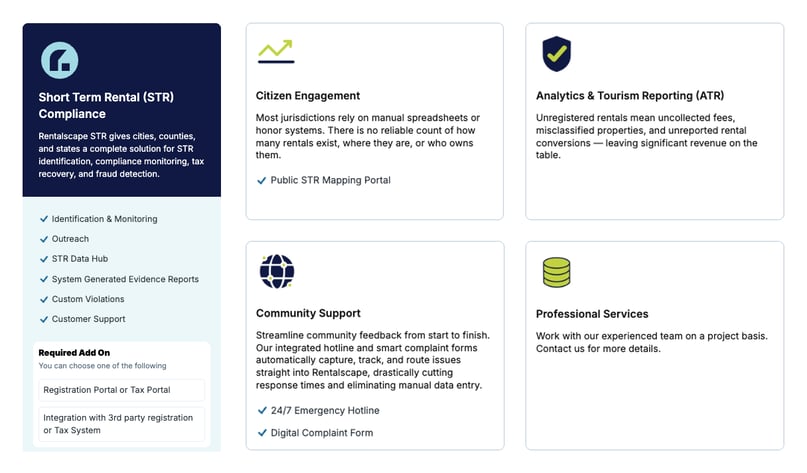
Figure 1: Rentalscape's core STR package and the add-ins a jurisdiction can layer on. Source: Rentalscape Product Packages, Deckard Technologies.
Seven pricing questions to put in your RFP
1. How is the fee calculated: flat subscription, per rental, per listing, or a share of recovered tax?
2. What is the base platform fee, and what does it include?
3. If the fee changes with the number of rentals, where is the cap? Ask for year-two and year-three ceilings in writing.
4. Which modules are add-ins, at what price, and can we add them later?
5. Which professional services are billed hourly, and at what rate?
6. What is the renewal notice period, and what drives increases?
7. Who owns the property records and evidence files, and can we export them if we leave?
If a vendor can answer all seven clearly, you have what you need to project costs over several years. If not, you'll know only what year one costs and find out the rest at renewal.
The year-three answer
Back to the hearing. The finance director's year-three question comes down to two numbers: what the town will pay under the model it chose, and what the program will have returned by then.
|
If you want a real answer for your jurisdiction, get in touch. We'll run a discovery of your rental market and give you a price for the modules you need, years two and three included. |
 LinkedIn
 Facebook
 X